
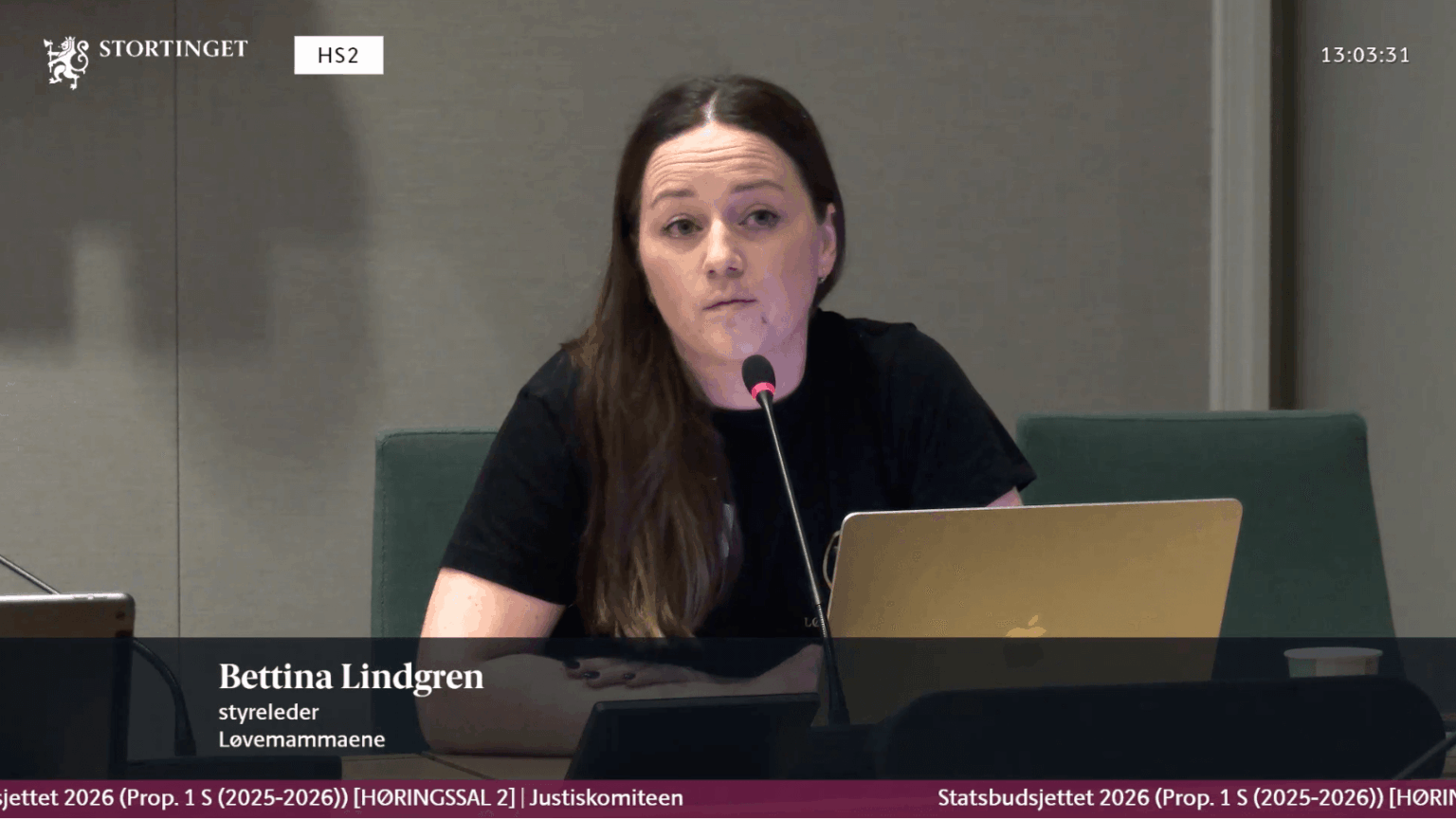
Today, the Lion Mothers participated in the oral hearing on the Ministry of Justice and Public Security's budget for 2026 (the state budget). Chairwoman Bettina Lindgren participated on behalf of the organization.
The Lion Mothers have also submitted a written consultation note to the committee members ahead of the oral hearing, in which we raise everything from the Public Administration Act, legal certainty and legal aid in municipal and state decisions.
You can see and read both below here.
The oral hearing in text format
Løvemammaene is a diagnosis-independent national organization for children and young people with serious illnesses and disabilities. We have 9,500 members and are gaining around 100 new members a week, so many find their way to us. So Løvemammaene represents parents who are in a constant cross-pressure between care, bureaucracy and the fight for very basic rights.
Many of us spend more time writing applications and complaints than actually being parents to our children. When the system fails, it has disastrous consequences for our children and for our entire family life.
We have parents in our network who have lost their children – that is, the children have died – while the case was in the appeals queue. Fighting for vital services and then losing the fight because the system takes months and years to process your case is an experience of hopelessness and total powerlessness. This is not due process. And that is why we are here today.
One of the main reasons why our member families are in these situations is the total lack of deadlines for the public sector in the Public Administration Act. “Without unjustified delay” is the deadline. Today, we are the only ones who have absolute deadlines in the law. The deadlines are anywhere from 2 to 6 weeks, and if we do not meet these, then too bad for us. The public sector has none. We understand that resources are scarce and busy in the public sector, and that the working day is over four o'clock, and that you cannot process cases after this. But try up to 24-hour working days, 365 days a year, without holidays, overtime pay or the opportunity to take time off. And then we are expected to respond within 3 weeks.
Many of our members also experience that municipalities in particular speculate on the fact that parents never stop doing everything they can for their sick child no matter what. Because it's not exactly like us to just leave our children on the steps of city hall when we can't take it anymore. So life is put on hold – for the foreseeable future.
The lionesses were on this committee last year too, and the year before that too. We asked for the same thing then as we are asking for now. We must have deadlines in the Public Administration Act that also apply to the public sector. There cannot be such discrimination between the public sector and people who need services.
For some families, it is actually a matter of life and death. When the state itself violates the intent of the law, and leaves children and families for years without both answers and proper services, then we can no longer call ourselves a state governed by the rule of law.

Written consultation input from the Lion Mothers
The Lion Mothers represent seriously ill and disabled children and youth, and their families. We have over 9,400 members. We are concerned that the budget proposal for 2026 because of what it not accommodates.
The Administrative Act
The Public Administration Act is a law without the teeth it needs. Today, there are no real deadlines in the Public Administration Act. Section 11 a only states that "the administrative body shall prepare and decide the case without undue delay.".
It sounds good, but in practice it means nothing. The administrative agencies always find "reasons" for suspension, such as understaffing, vacation processing, sick leave or "many cases". And when they violate this duty, nothing happens. No reactions. No consequences.
The consequences are instead borne by the families who are already on their knees. Parents have to quit their jobs, lose income, children lose necessary health care, and everyday life collapses. We are talking about children who need medical follow-up, supervision, relief and security – not about patience with the system.
At the same time, we parents have absolute deadlines. We must appeal within two to six weeks. If we exceed the deadline, we lose our right to appeal. The system therefore holds families accountable with short and strict deadlines, while the administration itself can spend months and years responding. This is fundamentally unfair, and it violates the principle of balance of power between citizens and the state.
In 2023–2024, the Storting adopted a series of motions (no. 968–972) to tighten the requirements for case processing time and the right to a reply, strengthen the duty to provide guidance so that the information is actually understood, ensure alternatives to digital solutions, and publish statistics on expected and actual case processing times. In this year's budget, the Ministry of Justice states that these resolutions "shall be followed up", but no specific proposals are made regarding statutory deadlines or a timetable for a new Administrative Procedure Act. Families are therefore still left without a real timeframe for when a case should be completed.
The lion mothers are calling for the government to present specific legislative proposals during 2026. Families who live with continuous caregiving tasks cannot wait months and years for municipal or state decisions.
We remind you of the National Audit Office's "Examination of health and care services for children with disabilities”. Document 3:15 (2020–2021). They conclude that:
- There are large differences and insufficient capacity in the health institutions' habilitation services for children.
- There are large variations between the municipalities in the use of relief.
- The state administrators' handling of the complaints has a great impact on the services the families receive.
- The families must take a great deal of responsibility themselves for getting help and coordinating the services.
"The National Audit Office considers it serious that the services for families with children who have disabilities depend on where they live, and that the parents themselves have to do a lot to get the help they need. The allocation of services to children with disabilities varies widely between municipalities. The municipalities' allocation is also affected by the fact that there are large differences in the habilitation offer between the health regions, both in terms of investigation and diagnosis, and the guidance provided by the municipalities. Furthermore, the municipal variations are connected to the fact that the state administrators have different practices in handling parents' complaints about the municipalities' decisions."
In other words, there is also a need for clearer authority for the State Administrator.
The legal certainty as the appeals system is set up, and with the State Administrator's lack of authority, does not reflect the exercise of power to which several families with burdensome care work may be exposed. The families are at the mercy of help from the public in order to have a livable life. When the municipality does not take care of its duties and fails grossly, the State Administrator lacks real authority to step down.
The lionesses believe it is high time to legislate clear deadlines in the Public Administration Act, and introduce sanctions when the authorities violate them.
It must be possible to make the same demands on the state that the state makes on families. Every day in the complaint queue is a day children live without due care.
Legal security that disappears when the child is sick or disabled
When the state believes that a child is being neglected, child welfare services can intervene and take over care. It is strictly regulated, the cases must be tried by a board, and both the child and the parents are provided with legal counsel at the state's expense. This ensures legal certainty, as it should be in a society based on the rule of law.
But when the state decides that a seriously ill or disabled child must be moved to an institution – not because the parents are failing, but because the municipality is unable to provide enough help at home – there are no such rights. No board, no automatic judicial review and no legal aid lawyer. The child and the family lose the right to be heard, to be tried, to receive legal aid, even if the measure is at least as intrusive as a care transfer.
This is happening in Norway today. Children are being removed from their homes against their will and that of their parents, without the need for legal action. It is a serious violation of the rule of law, and in violation of both Section 104 of the Constitution and the UN Convention on the Rights of the Child, which establishes the child's right to grow up with his or her family.
Legal aid for municipal and state decisions
The new legal aid scheme expands certain prioritized case types, but municipal health and care decisions are still not prioritized. They still fall under the exception rule of «special welfare significance». This affects families who have to sue the municipality for necessary services, BPA, relief or housing measures. And experience has shown that families do not dare to pursue these cases for fear of being financially ruined. We therefore ask the Storting to make municipal health and care decisions a prioritized case type in the Legal Aid Act, in line with child welfare and social security cases. This will ensure that parents with children in need of care have real access to rights that currently only exist on paper.
The lionesses ask for:
- that specific case processing deadlines are legislated in the Public Administration Act.
- the right to a preliminary response when the deadline cannot be met, and automatic follow-up and the right to appeal when deadlines are broken.
- that sanctions are introduced when public bodies break deadlines.
- that children and parents have the right to legal counsel in cases where the municipality, without consent, makes a decision to move the child out of the family home due to service needs.
- a strengthening of the State Civil Law Administration and the state administrators for faster case processing.
- that municipal health and care decisions be made a prioritized case type in the Legal Aid Act.
With best regards
The lion mothers
 English
  Norsk bokmål
  العربية
  Français
  Deutsch
  हिन्दी
  كوردی
كوردی  فارسی
فارسی  Soomaali
  Español
  Kiswahili
  தமிழ்
தமிழ்  Tigrinya
  Українська
  اردو
اردو