
Help, we're going on vacation! The lion mothers are constantly asked about what rights you have, what is allowed or advisable to think about when going on holiday with children with functional variations and/or medical needs. In this article, we have collected information and good advice for you.
First and foremost: Plan your vacation well in advance!
The lion children have different challenges. If the child has complex medical challenges, it may be a good idea to spend the holiday somewhere where you will have access to the same or almost the same expertise and treatment as at home should the child need it.
Necessary documents
Medical certificate
It may be a good idea to bring an updated doctor's note with full name and birth number in English that says something about the child's diagnosis/challenges and what medicines and equipment the child must take with him on the trip. Ev. important information about medical considerations, CAVE (medical term meaning "must not have" or "contraindicated") ol should also be listed here. It can be useful both through the security check at the airport and if you are unlucky enough to end up in a hospital abroad.
For medically complex children where there may be a number of medical expressions that may be difficult for customs and airport staff to understand, it may be advisable to get a more specified declaration, possibly an additional document that provides concise information about medicines, medical equipment (pumps), medical consumables, and about some of this, e.g. cannot be stored in the hold during the flight.
European health insurance card
Travel insurance and rights to emergency help and treatment within and outside EU/EEA countries are discussed below.
The European Health Insurance Card documents that you and your children have the right to cover necessary healthcare in another EEA country on the same terms as the country's own citizens. The health insurance card entitles you to cover necessary medical treatment at a hospital and/or with a practitioner affiliated with the public health system in the country in which you are staying. You/the children are entitled to cover on the same terms as the country's residents, and you must pay the same deductibles as them. Please note that the standard of treatment can vary from country to country, so you cannot necessarily expect to receive the same treatment as you would receive in Norway. When assessing what treatment is necessary and what the health insurance card entitles you to, account must be taken of the type of health service in question and how long the stay is intended to last. You have the right to the health services that are necessary for you to continue your stay in the country you are visiting in a medically sound manner.
In countries where you have to pay a deductible like the other citizens, you can in some cases apply Hello about reimbursement for. In that case, this is done through HelseNorge.
The health insurance card will be able to entitle you to certain necessary nursing and care services according to the rules of the country you are traveling to. Here you must contact the country of residence yourself to find out which rules apply.
European health insurance card can be ordered via Healthcare. Log in with bankID, go to one of the parents/guardians' profiles and then press yes for the whole family. Within 1-2 weeks, you will receive your health insurance card in the post.
NB! The health rights you have under the EEA Agreement are limited. It is therefore important to have private travel insurance in addition to the health insurance card.
Europeisk helsetrygdkort erstatter ikke reiseforsikring.
Private travel insurance
Privat reiseforsikring vil som regel kun dekke akutt hjelp og uventet sykdom. Dekning ved eksisterende sykdom varierer mellom forsikringsselskapene. Det er derfor viktig å kontakte forsikringsselskapet før reisen og avklare hva som er dekket i akkurat deres situasjon.
Children under the age of 21 are generally covered by the mother's/father's insurance. The children must have the same registered address as one of their parents.
If you have seriously ill children, you must therefore double check whether the travel insurance will cover a possible hospital stay and/or transport back to Norway in the event of a change/worsening of the illness. Here it may be important to have documentation from the treating doctor in the specialist health service that the patient is stable in terms of his illness so that the travel insurance is valid. Otherwise, you risk being left with the entire bill for both medication and hospital expenses, and in the worst case for getting the child home to Norway before the original return ticket. If you are traveling outside the EEA/EU, it is particularly important that this is in place!
Schengen certificate
For all medicines that fall under prescription group A or B, you must have a document with you (Schengen certificate) together with the medicines. This applies to travel to all countries, including in the Nordic countries. It is important that all medicines are labeled with the pharmacy label, which states the patient's name and dosage. To find out if you need this, you can either ask at the pharmacy or look up The joint catalogue. In the Common Catalog you can look up the medicine and if it says A or B under the medicine name with a picture of a suitcase, then you must have such a certificate.
We recommend that you have a medical certificate for A preparations such as morphine, which ensures documentation that you need to use this abroad. Not least when you are going back home to Norway, if you should be stopped at customs.
Care allowance abroad
Det er mulig å motta pleiepenger under opphold i utlandet dersom vilkårene for pleiepenger fortsatt er oppfylt.
Ved midlertidige opphold i EU/EØS-land og Norden trenger man som hovedregel ikke å søke NAV på forhånd for å beholde pleiepengene. Reisen må likevel ikke komme i konflikt med avtaler med behandlere, NAV eller andre forhold som har betydning for retten til ytelsen.
Ved opphold utenfor EU/EØS og Norden må man kontakte NAV før avreise for å avklare om pleiepengene kan beholdes under utenlandsoppholdet.
InReglene kan endres, og det anbefales derfor alltid å kontrollere gjeldende informasjon hos NAV før man bestiller reisen.
You must notify NAV if you are going to a country outside the EEA. When you travel outside the EEA and your right to care allowance is fulfilled during the period, you can receive care allowance for up to 8 weeks during a 12-month period.
You notify NAV by calling or sending a message via your page at NAV.no. You must let us know which country outside the EEA you will be traveling to, that the child will be with you, how long you will be there, and whether you will receive childcare allowance during the period or take a statutory holiday.
Emergency plan
Har man et alvorlig sykt barn kan det være lurt å lage en akuttplan med dem man reise med som går gjennom akutte situasjoner som kan oppstå, f.eks. epilepsianfall, blodsukker, pustebesvær, problemer med stomien, infeksjoner m.m. Når man er på nye steder blir det langt mindre stress hvis man kan nødnummeret, vet hvor man skal ringe, aktuelle adresser, hvordan man kan oppgi en kartreferanse, hva diagnosene heter på internasjonalt legespråk o.l. i det landet man skal oppholde seg i. Legespråket er latin og likt i alle land, med små justeringer. Da er det lettere å få rett hjelp til rett tid. Oppbevar gjerne akuttplanen både digitalt og på papir.
Er du medlem i Løvemammaene, kan du laste ned mal på akuttplan i vårt lukkede intranett for medlemmer: Spark
And remember, if something urgent has happened on the flight down to the destination and you are going home with the same travel company, it may be a good idea to contact the travel company before you go home. This is to get clearance from the airline's doctor/medical team. Read more about this under "travel by plane".
Can you take medicines, milk, tube feeding, intravenous nutrition etc. into the security check?
Yes, you can take all medicines, food, wheelchairs and other equipment that the child depends on through the security check - even liquids over 100 ml. It is recommended to bring a doctor's note supporting the need.
Many airports have their own family and/or HC gates at security, which may be worth noting before queuing.
NB! You must check in manually at the counter at the airport when traveling with special luggage (wheelchair, medical equipment etc. are considered special luggage).
Can we take aids from NAV, and medical equipment and oxygen from the Treatment Aid Center abroad?
All personal aids (from the NAV aid center) can be taken abroad. Men det kan være utfordringer å få reparasjoner i et annet land. I så fall må man ringe lokal hjelpemiddelsentral fra utlandet og avtale med dem. Noen firma som leverer hjelpemidler i Norge, har også kontorer i andre land og kan hjelpe til med reparasjoner. Man kan risikere å måtte betale kostnadene selv, og kreve dem refundert når man kommer hjem. Men husk avtale med hjelpemiddelsentralen, før man legger ut, avtal kostnadsrammen, slik at man ikke sitter igjen med en regning på reperasjon man må bekoste selv. Ta gjerne bilder av hjelpemidlene før reisen. Dette kan være nyttig ved skade, tap eller forsikringssak.
Treatment aids, hospital pharmacy and bandage specialist (affiliated to the health institutions) which lends out medical equipment such as pumps, equipment for oxygen, CPAP etc. and supplies other consumables such as syringes, catheters, ostomy equipment etc. basically has no service agreements in other countries. You must therefore bring all disposable equipment and preferably some spare when you travel, as it can be difficult to obtain disposable equipment in the country you are holidaying in. If there is a fault with technical equipment, the local treatment aid center must be contacted for further advice.
When it comes to sharp objects such as ostomy scissors, they are allowed in your hand luggage. Adhesive removers (aerosols) should not be sent with checked baggage and must be presented at the security check (max. 100 ml in hand luggage, ref. main rule on liquids). It may be advisable to bring a doctor's note explaining that you must bring such ostomy equipment. Coloplast can also send you free of charge travel certificate (in several languages) which can be shown at the security check at airports.
Oxygen equipment (flasks and concentrators) cannot initially be taken abroad. If the child needs oxygen treatment abroad, you may be entitled to have the costs for this covered or reimbursed. Remember to start planning well in advance!
Here, too, you must ensure that you get a doctor's certificate that clearly states that the child needs oxygen treatment during the flight and/or that he has a persistent or regular need for oxygen. You must enter into an agreement with the supplier of the oxygen equipment you need. It can be an airline if the need is only valid on the flight itself, or a treatment facility (hospital at a resort) or an oxygen supplier (e.g. Linde Healthcare or Meditek), if the need for oxygen treatment is persistent/regular. Then you contact the supplier in question, present a doctor's certificate and European health insurance card (if applicable, prior approval from Helfo) and complete the order for equipment with the necessary information it may entail. The supplier will be able to deliver the oxygen equipment you need directly to the resort/hotel room you will be staying at, and to the flight itself if applicable.
It is a good idea to check what is in force in the country you are going to. If you are going to travel within the EU/EEA and Switzerland, the child must initially have the costs of oxygen treatment at a public treatment center covered by showing a European health insurance card. You will then only have to pay the same deductible as the residents of the country you are staying in. If the treatment center does not accept the European Health Insurance Card, you must pay for the treatment for the child yourself and apply to Helfo for reimbursement after the trip. Application for reimbursement of expenses must be sent to Helfo no later than 6 months after the trip. A stay abroad is considered one continuous oxygen treatment, and the deadline is calculated from the date the trip ends (return date). Together with the application, the original specified invoice and a confirmation that the treatment has been paid must be attached. You must also attach the doctor's statement as mentioned above here. Alternatively, the doctor can confirm the need by signing and stamping directly on the application form.
It is also possible to get prior approval from Helfo so that you avoid large outlays in terms of the oxygen treatment on the journey. Contact Helfo if you need this.
How to bring medicines, tube feeding and intravenous nutrition abroad safely, and how much should you bring?
As far as possible, you should take everything you need abroad with you, and this should not be sent in suitcases to the luggage compartment on the plane. Not all medicines and products can withstand the temperature in the hold. In any case, it should be checked with the pharmacy whether it can be transported in this way. We recommend that you carry medicines and necessary equipment for at least 3 days in your hand luggage. If your luggage unexpectedly goes missing, you will have enough time to get a new one at the resort.
Intravenous nutrition requires planning at least 6-8 weeks before departure!
Check with the doctor if you can get ready-made bags that do not need refrigeration and have a longer shelf life than a week. In many cases, factory-made bags can be used for short periods, such as e.g. on holiday, so that you don't have to have intravenous nutrition made abroad. Then you only need to order from those you normally receive intravenous nutrition from, and avoid contact with HELFO and hospitals abroad.
If this cannot be done, you must do the following:
- Obtain a doctor's certificate for Helfo which states that this is vital and that you need this on holiday. And that this is a continuation of treatment you have at home, which goes under an advanced home hospital.
- You have to find a place yourself that can produce this, this requires you to get the recipe from your local hospital pharmacy. When you have made contact with a hospital pharmacy abroad that can produce for you, you must put them in contact with your hospital pharmacy. Then they can clarify that they have the right approvals to produce exactly your child's mixture.
- Clarify that they accept the use of the Health Insurance Card, i.e. that they send an invoice through the health system. If the residents of the country you are going on holiday in must pay a deductible, you must also pay this.
- A doctor affiliated with the hospital pharmacy abroad must, once the mixture has been approved and the financial settlement has been settled, enter a prescription for the mixture in the country you are going on holiday in, and you must arrange collection/delivery yourself.
- When you get home, you can apply to Helfo for a refund of the deductible.
You must bring pumps and all disposable equipment with you from Norway, note if a pump breaks abroad, you have no right to have the health care provider repair it when you are in another country. Remember the medical certificate for customs, why you need so much medical equipment with you. As this quickly exceeds the limit of what you are allowed to take with you in the form of valuables. Remember also to check the customs regulations of the country you are entering, possibly intermediate countries.
What do we do when we have a child who needs medicines/nutritional products with a short shelf life?
If you need to collect medicines, nutrition etc. abroad, you have to see a local doctor who must make a prescription. It is important to bring a doctor's note in English that explains the need, which medications and dosage. If there are special medicines that are required to be prescribed by the specialist health service (hospital) abroad, this hospital must be contacted before departure, so that the doctor there has the opportunity to speak to the treating doctor in Norway. If you travel outside the EU/EEA, you often have to seek prior approval for the expenses you will incur abroad. In any case, it may be a good idea to call Helfo before traveling abroad if you need medication, nutrition or intravenous nutrition. There you can get the guidance you need and get a guarantee for the hospital where you need to pick up special medicines.
Helfo has no direct reimbursement with pharmacies abroad, so you must always pay for medication yourself and get this reimbursed when you are back home, as long as you have a blue prescription or individual approval for the medication. There are only special nutritional supplements and medicines that must be prepared at a hospital pharmacy, for which you can avoid paying the cost with a decision from Helfo and/or the European Health Insurance Card.
NB! Not all medicines have a marketing authorization in all countries, or fall under what we call the blue receptor classification in Norway. This may mean that you have to pay the full amount for the medicine locally, and then apply to Helfo for reimbursement for the costs. Remember that these can be large sums (!), so it's a good idea to research this in advance and consider having a credit card with you as security. In Denmark and Sweden, they have their own agreements, so that it may be easier to get this done in these countries than in other countries.
Travel by plane
Children can have different challenges when it comes to traveling by plane. Some may find it difficult to sit in their own seat without support, some may need oxygen or use a respirator, some have limited/no walking function and need a wheelchair to enter the plane, while some need shielding/noise reduction. The most important thing you can do is inform the airline. You will then receive an extended package at no extra cost for what you need to bring with you. Contact the airline as soon as possible, no later than 48 hours before departure and inform them of this, unless you have already informed them in the booking. In any case, it may be a good idea to double check that they have registered it so that you don't have problems at check-in. NB! It's a good idea to ask for confirmation to be sent by email.
Wheelchair to the street/into the plane
There are often long distances at the airports and you want to have energy left for the journey itself. You can order assistance from the moment you enter the airport all the way onto the plane. There are different needs, and you order based on the need. It is possible to borrow a wheelchair at the airport or bring your own. If you travel with your own wheelchair, you will be asked to provide measurements (weight, width and height).
It may be good to note that airlines operate differently when it comes to labeling wheelchairs/special luggage (priority marking), without necessarily having any particular significance for their journey. This can be requested in any case.
You can use your own wheelchair right up to the plane. Then they carry the wheelchair down to the hold when you have entered the plane, and up to you when you are leaving.
In case of assistance to the plane, you get in first and get out last.
If the plane does not park right next to the gate and you cannot get to the plane via a footbridge, or it is difficult to get onto the plane for other reasons (size, weight, movement restrictions), the airport can use a special "HC truck" (see image below ).

ATTENTION! Not all electric wheelchairs can be taken into the hold of the various planes. Here it is important to check with the airline before booking. Some airlines require the battery to be disconnected during flights.
See also tips on SSR codes further down in this article.
Tomato seat or other seating aids on planes
Again, we are back to this with the importance of a good medical certificate that says something about the child's needs. The different airlines may have different rules for what is approved to be used on the plane in the seat. There is usually information on the websites of the airlines, if not you should contact customer service and find out what they accept and can offer in terms of support in the plane seat.
Oxygen and other breathing aids on planes
If you are traveling with oxygen or other breathing aids on a plane, you must be informed about this in advance. You can travel with oxygen in both flasks and concentrators on planes, just remember a doctor's note.
ATTENTION! If the child is dependent on a more advanced breathing aid/respirator (or has another serious condition that entails a high risk of emergency situations that could force the plane to make an emergency landing), the airline may require an additional approval from the airline's doctor for their child to fly. In the worst case scenario, you may be refused a flight, so it is important to inform and clarify this before/immediately when you book.
Medicines/equipment and other needs
If the child needs medicines, medical equipment, nutritional products, allergies or a special diet, you should call the airline's customer service when you book the journey and inform them of this. Remember the doctor's note.
SSR codes for flights
Airports and airlines offer assistance and other support to millions of disabled passengers every year. When you request a type of assistance or report a need, the airline codes it into the ticket register using a special code - SSR. These different codes allow the airlines to easily keep track of the different types of assistance requests and needs so that they can help accordingly. It is important that the correct code(s) are entered into your ticket to ensure that the assistance provided is correct and appropriate. You should call and have the relevant SSR codes added to the ticket when booking or shortly afterwards. Advance notice gives airlines and the airports the best possible starting point to manage and make arrangements for you.
The tables below identify and define the types of assistance and SSR codes for air travelers with functional variation.
Table 1.
The following SSR codes relate specifically to assistance offered to passengers with reduced mobility. These codes are used by most airlines, but some foreign airlines may use a different format.
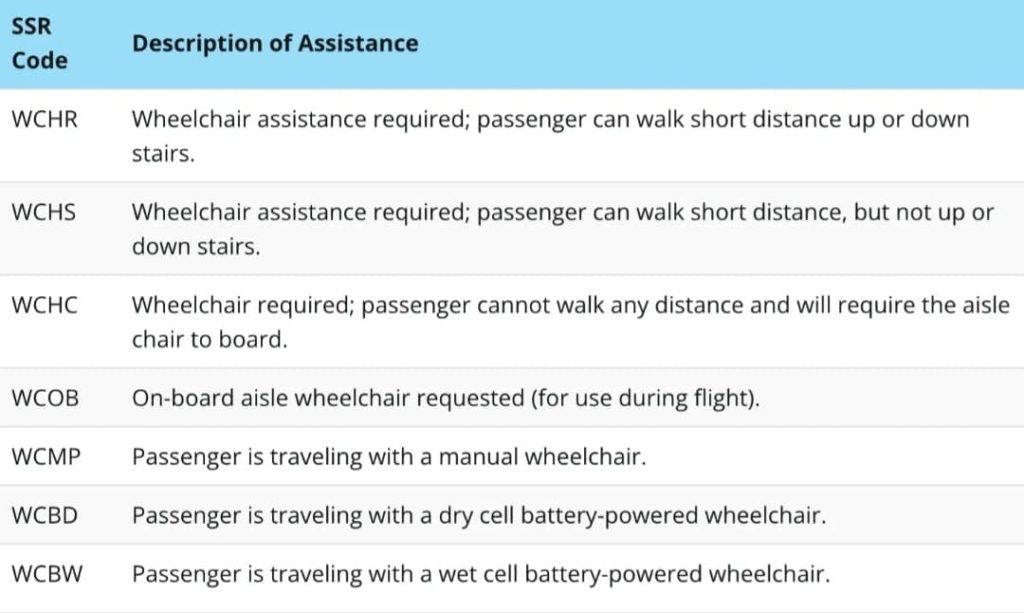
Table 2.
The following SSR codes address other functional variations and assistance needs, and can be used in conjunction with the wheelchair assistance codes. This list is not exhaustive. Passengers requiring any of these services should insist that the airline update their ticket with the relevant SSR codes.

Barn med nevrotypiske diagnoser på flyreise og ellers på reise
By using the DPNA code, you will be given priority at check-in and boarding. There must be an opportunity for own drinks and food, priority for using the toilet or getting up on the plane. If there is a lot of verbal, loud noises, the cabin crew must help inform passengers if there are reactions in the aircraft.
We can also recommend bringing an explanation card with a description of e.g. autism, ADHD, Tourette's etc. which can be given out to those closest to you when needed. It can be saving in terms of looks and misunderstandings, as well as the fact that you do not have to explain the diagnosis over the child's head.
It may be a good idea to bring aids that screen/calm the child. All children are different, but measures that can help can be fidget toys, noise-reducing headsets etc. If you download episodes/songs/audio files on e.g. Netflix/Spotify before departure can be played on the plane even if the device is in flight mode.
Travel by boat
Reiser man flere og har samme kategori på lugaren, kan man be reiseselskapet om at man får lugar ved siden av/i nærheten av hverandre. Eventuelt bord når man skal spise, bestiller mat før, man kan be om bord i et hjørne/avlukke dersom behov for skjerming, hvis de har mulighet til det så klart. Det er mange plasser å gjemme seg på en båt. Ha gjerne navnebånd på, skriv navn på foreldre, lugarnummer og telefonnummer i tilfelle barnet skulle komme bort fra dere. Under overfart er det ikke sikkert at det er dekning på telefonen, så da kan navn og lugarnummer hjelpe ansatte å finne foreldrene. Dersom det oppleves trygt og hensiktsmessig, kan man vurdere å oppgi relevant medisinsk informasjon på navnebånd eller ID-kort. Dersom noe skulle skje med barnet og du ikke er der, vet de ansatte og skipslegen hvordan de skal behandle og komme i kontakt med foreldrene.
ATTENTION! Oxygen must be notified that you are taking it on board. It is important with the type of oxygen (flask or concentrator), quantity and size. Which compartment it is stored in, possibly what is in the car. You must be informed about this when ordering, and when you check in on the boat itself.
Resorts that are extra functionally friendly
There are some assisted living resorts around the world.
We have by no means mapped everyone, but can come up with some examples.
Norway: Gurvika holiday centre
Sweden: Valjeviken Mättinge
Denmark: Aabo Village Handicap-friendly luxury cabins
Spain: Solgården holiday and health centre
USA: Morgan's Wonderland
UK: Experience freedom glamping getaways
In Norway you can also use Map of Norway to find suitable/accessible places for e.g. trips and outdoor activities, HC car parks, city, buildings and the like. Here you can tick off which aids the child uses as well. There are strict rules, so some places may be red even if you still get through. Money has been allocated from the state to register this, so it is an ongoing work.
The Norwegian Tourist Association also has several adapted offers. They work to make outdoor life more accessible to people with a variety of functions, and arrange trips and activities that are suitable for many. Worth checking out.
On A trip have they collected information about stations and stops in Norway where assistance services are offered, should you choose to travel on a domestic train holiday.
Other tips
Car holiday
A smart investment can be seat belt cover with important information about diagnosis and medical needs, e.g. diabetes, autism, heart rhythm disorder. If you are unlucky and are exposed to a car accident where you are unable to help the child, this will be useful for health personnel who arrive at the scene and they can save lives.
Visually impaired/blind
Det kan være fint å være synlig for små barn med sterk synshemming. F.eks. ved bruk av refleksvest eller t-skjorte som viser den blinde og med synlig ledsager, vil det være lettere for andre folk å ta hensyn. Se eksempel i vår nettbutikk here.
Cart used as a wheelchair
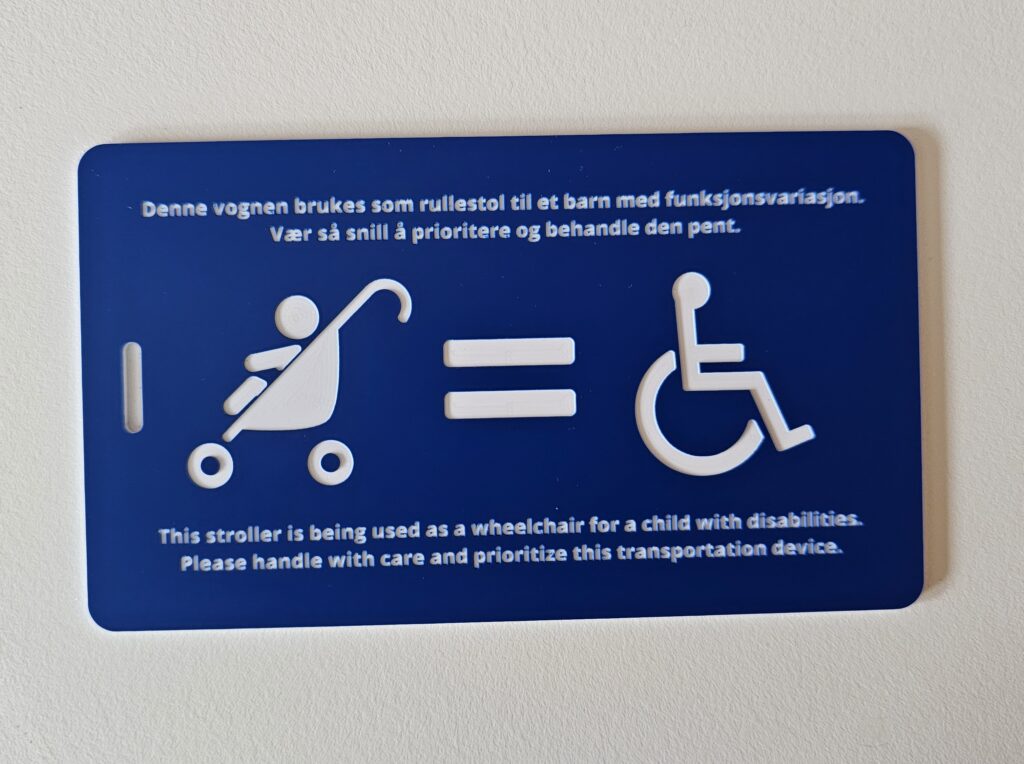
Tired of your child's pram being used as a wheelchair being handled too roughly? E.g. when traveling when it is sent as luggage on a plane. Or that people don't understand why you use the HC seat on the bus? A sign like this can be useful to have attached to the cart.
Medicines and equipment during and after the holiday
It is important to order everything needed for the holiday well in advance. This is due to public holiday closures and the fact that it is generally common for processes to be somewhat slower in the summer. Another tip is to order a small stock before the holiday, so that you have everything you need when you get home from the holiday too.
It may be a good idea to label the bag or suitcases in which medicines and medical equipment are stored so that staff on flights, hotels and transport take note. In our online store we sell these ingenious luggage tags.

Medisiner i håndbagasje
Ta alltid livsnødvendige medisiner, sondemat, ernæring, batterier, ladere, hjelpemidler og medisinsk dokumentasjon i håndbagasjen dersom det er mulig. Innsjekket bagasje kan bli forsinket eller komme bort.
Small emergency bag
It might be good to have one small "emergency bag" which can fit on the pram, wheelchair, over the shoulder or in the handbag. In it you can store equipment and medicines or things you know are very important for your child, and always have them easily accessible. This will be fine if you are going on a car holiday where you have to get on and off by ferry, or on flights. Content can e.g. be:
- extra PEG/button
- suction hose etc
- extra stoma change
- fidgets and sensory stimuli
- emergency medicines
- resuscitation bag
- extra probe hose, tape etc
Extra devices/equipment
It can be important to borrow extra devices that you absolutely depend on to work when you go on holiday. If something were to happen, it is very nice to have an extra set on hand. It can e.g. be:
- feeding pump
- CPAP/BiPAP/respirator
- cough machine
- suction machine
- insulin pump/blood sugar meter
- saturation meter
NB! Not everyone is as "generous" when it comes to lending extra equipment, but if it is essential equipment, the doctor should be able to help you apply for and argue for extra equipment.
In some countries they have their own lending centers with aids, e.g. pram, wheelchair, etc. To find out if there is one in the area you are going to, you can search for the place you are going to and suitable keywords, e.g. "rent mobility aid greece", or "rent mobility equipment turkey", or "accessible holiday mobility rental florida" and the like.
Support for holiday trips abroad
It is possible to apply for companionship support at Solgården. It is intended for people with a congenital or early acquired functional variation, mental or physical (before the age of 18), and who must have a companion to be able to travel on holiday to Solgården.
Travel to courses/conferences/"diagnosis meetings" abroad
Read more about this here.
Dette skrivet er sist oppdatert 30.08.26
 English
  Norsk bokmål
  العربية
  Français
  Deutsch
  हिन्दी
  كوردی
كوردی  فارسی
فارسی  Soomaali
  Español
  Kiswahili
  தமிழ்
தமிழ்  Tigrinya
  Українська
  اردو
اردو