
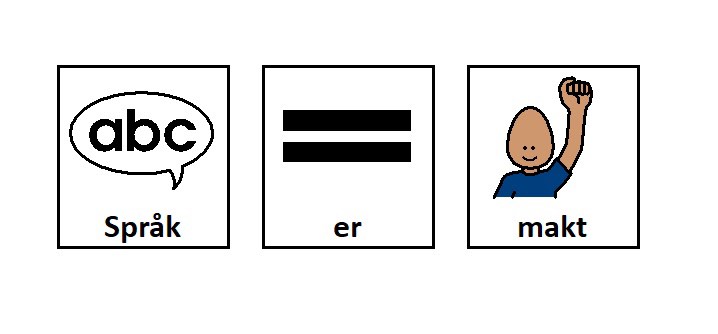
Children and young people who due to illness or functional variation have little or no speech need alternative and supplementary communication (ASK). Being able to communicate is a human right. See the UN Convention on the Rights of Persons with Disabilities (CRPD) article 2 and Article 24.
Communication is both linguistic and non-linguistic, and in addition to words also includes the use of facial expressions, looks and gestures. But, if we are to talk about things that are outside the room we are in, and which we cannot therefore see, touch or point to, then we need words (ie the linguistic part of communication).
Children learn the language used in the environment they grow up in. This happens quite naturally, as parents, family and other adults and children talk to the child in many and varied situations. The vast majority of children can use speech to express themselves, and although it is common for children to understand something more than they are able to put into words themselves, the gap between understanding and expressive ability is not usually that large. But for some children this is different and they understand more than they can express. Then the child needs ASK. Children may also need ASK if they struggle to understand language.
Not being able to express yourself can create frustration in the child. Sometimes this leads to the child instead "expressing" himself with behaviour - some children exhibit behavior that is perceived as defiant or aggressive, while other children become very quiet and passive. Both for that reason, and because children learn languages more easily the younger they are, it is important to get started with ASK measures early on. The ideal is for ASK measures to be initiated as quickly as possible after the need has been identified - preferably in the first year of life. This can be compared to speech - we don't wait until the child has started to talk before talking to him. We do this automatically right from the time the child is born. While it is desirable to get started early, it is also important to remember that it is never too late to initiate ASK measures. There are many examples of both young people and adults who have gained access to ASK and with it a completely new everyday life.
Parents, of course, know their child best and will often be able to understand what a child's needs are - for example if they are hungry, need a change, need comfort or want something - without having to use so many words. Some parents may therefore find that there is not much need for ASK as they understand their child anyway. It is then important to remember that in the longer term the hope is that the child will be able to express much more than primary needs, and that the child will be able to tell, wonder, joke, learn, ask, comment and protest about many and varied topics. To achieve that, the child needs words to express himself. And if the words cannot be expressed in speech, they must be expressed in another way. And as it takes time to learn a language, and children learn a language best when it is used a lot in the environments they are in, it is important that parents also receive training in ASK and help use ASK at home.
What is ASK?
ASK is the language that people who cannot use speech use to express themselves when they communicate face-to-face with someone. ASK includes both expressions that can be made with the body, such as hand signs, and the use of concrete, symbols or writing to express oneself linguistically. If you express yourself by using your body to make signs, it is called unaided communication. If you need aids in the form of concrete, symbols or speech machines to express yourself, it is called aided communication.
Should you say cat without using speech you can either:
- use the hand sign for KATT from sign-to-speech/Norwegian with character support
- a concrete that represents the word cat
- symbol for CAT
- write cat
See examples:
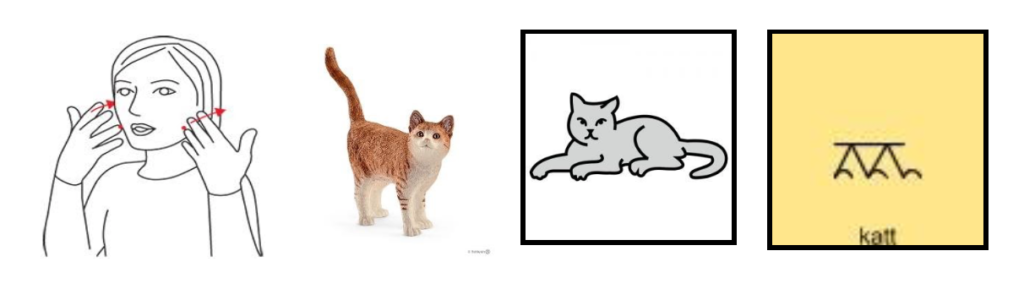
The illustration of the hand drawn cat is taken from minetegn.no while the symbols are taken from arasaac.org and blissonline.se
When the child uses symbols or writing to express himself, the child needs communication aids. We distinguish between paper-based communication aids, low-tech talking machines and high-tech talking machines.
Paper-based aids:
This includes both aids where a few symbols are used at a time - for example to choose an activity -, boards where the vocabulary for an activity or a topic is presented together and books where symbols for many different situations and topics are collected.
Speech machines, both low- and high-tech:
Talking machines give the child a voice.
- On low-tech speaking machines, it is often a close person, such as mum or dad, who records the words which the child can then express by pressing a button with the symbol for the word.
- In high-tech, which includes both purpose-built PCs dedicated to communication and using a tablet with a communication app, synthetic speech is used.
It is often important to have both paper-based and technological communication aids, as they can have different uses. Sometimes it can be easier to take a board with a few symbols on it - for example at the beach or in the swimming pool. At other times, it is important to have the voice machine with you so that the child can have a more independent voice - for example in the classroom.
Who needs ASK?
Both children and adults need ASK. Common reasons why children need ASK are:
- That they have such great movement difficulties that they are unable to produce speech (as in some forms of CP).
- That they have a very serious language difficulty.
- That they have a developmental disability and are also linguistically delayed or have autism.
- That they lose their spoken language due to illness or damage to the brain.
Some children need ASK for a period of time. The largest group here are probably children with Down syndrome. As we know that children with Down syndrome are often more delayed in their development of spoken language than in their other development, and that this can create a lot of frustration, it is recommended to start with sign-to-speech and/or symbols in the first year of life. However, the vast majority of people with Down syndrome will develop speech and can therefore stop using ASK during childhood. Because ASK acts as a support along the way while spoken language is being developed, this user group is called the support language group.
Some children need ASK for life. We cannot always know for sure who it is when the child is small. At the same time, we know that introducing ASK measures promotes language development in general, gives the child an opportunity to express himself if spoken language is not forthcoming, and also helps to promote spoken language development if the child has the motor and/or cognitive prerequisites for it. It therefore can't hurt to start with ASK - quite the opposite.
We often divide the children and adults who have a lifelong need for ASK into two groups; the means of expression group and the language option group. The expressive means group understands the spoken language used by the people around them, but cannot express themselves with speech – usually due to major motor difficulties. The language alternative group struggles to understand the spoken language. It has been shown that it can be easier to understand when hand signs or symbols are used together with speech, and that this also gives children and adults with major comprehension difficulties an opportunity to express themselves.
What kind of aid should my child have?
There are many different ASK aids and many different reasons why a child needs ASK. It is therefore important to find the aid that suits your child's needs. There are no one-size-fits-all aids; what works well for one person will not necessarily work well for another - even if the children have the same diagnosis.
This means that if you believe that your child needs ASK, you should also request that your child receive an assessment. This assessment should often be interdisciplinary, but it will of course depend on the extent of the child's difficulties.
When a child does not develop spoken language as expected, the child's hearing should always be checked. This is to ensure that it is not a temporary or permanent hearing loss that is the cause of the delay. It may well be that the child benefits from ASK even if he has a hearing loss, but measures should first of all be put in place to improve his hearing - if that is possible.
If it has been established that the child needs ASK, it is also important to know something about the child's visual function and how the child uses their sight and interprets visual impressions. This is because many forms of ASK are highly visual, and that some children also use their eyes to point (either on paper-based communication aids or on talking machines with eye control equipment).
If the child has motor difficulties and cannot point precisely to symbols or letters with a finger, an occupational therapist should investigate how the child should operate their communication aids. The occupational therapist often collaborates with a physiotherapist, for example to ensure that the child sits well in the wheelchair and has as good conditions for controlling the arm or head as possible.
Some children who do not have spoken language understand as much as other children of the same age, while other children have a reduced level of understanding. We can rarely be sure of the child's level of understanding without investigating language and cognition. Such investigations are usually carried out by pedagogues and psychologists, under the auspices of PPT, Statped and/or HABU (child and youth rehabilitation).
Language environment
ASK is not primarily aids - the aids are only a way of giving the child access to language. It is therefore very important to think of ASK as a language. Only when staff in kindergartens and schools understand that ASK is the child's language will they seriously realize how important it is that everyone in the environment, both adults and peers, knows the child's language and that the aids the child has are available everywhere and in all situations . Recognizing ASK as the child's language also means that the importance of good language models, having access to many communication partners, being able to communicate on many and varied topics, being allowed to use one's language to learn and to show what one has learned, becomes of course.
ASK is always used together with spoken language, and will therefore also support language development in general. But language is not only learned through observation – it must also be used. The child therefore needs access to ASK throughout the day and in all situations. Not only where we adults want to know what the child's preferences are, but also so that the child can participate and be active in play and socializing with peers. It is not enough to just listen and possibly confirm/deny suggestions; children with ASK needs also need to be able to take communicative initiatives; suggest new toys, say something unexpected during assembly time, ask a surprising question in class, disrupt the lesson by chatting with the person next to you - and of course get told off for this in the usual way. Some are anxious about using hand signs or symbols incorrectly, but unfortunately the most common mistake made against children who need ASK is that we do not give them access to their language but instead assume (often in the best sense) that we know what the child wants to say.
Rights and instances
PPT is often the first agency contacted if the child shows signs of delay, unless the difficulties have been known since the child was a newborn. Regardless of whether the child is followed up by Statped or in the specialist health service (such as HABU) in addition, it is important to have contact with PPT. Only PPT is an expert body in relation to the Kindergarten Act and the Education Act. It is important that the PPT takes into account the need for ASK, including what aids the child needs, how ASK should be implemented, how a good language environment should be created for the child, how children of the same age should receive training and guidance in using ASK, as well as how a good learning environment must be created. On the website of the Directorate of Education (udir.no) are points that PPT should take into account in the expert assessment specified.
In the Kindergartens Act §39 and in the Education Act §2-16, it is specified that children who fully or partially lack functional speech and who need ASK, must be allowed to use suitable forms of communication and the necessary means of communication. Using ASK is therefore a right that children have in kindergarten and students have at school, regardless of whether they need special education, but the school must not make any individual decision about the need for ASK. It is specified that training in using ASK can be included as part of the special educational help given to children of kindergarten age or be part of the special education given to a pupil.
If the PPT does not have the competence to help a child, the PPT can apply for assistance from Statped. Statped, specialist department of vision, has special expertise in the assessment of functional use of vision. The specialist department for complex learning difficulties often assists when children need ASK. Statped have created an e-learning course about ASK, which is free and also has resources such as Good ASK. These can be recommended both for parents and for staff in kindergartens/schools.
All children with CP must be offered regular follow-up at the local HABU, which can be found in each county. If your child has CP and needs ASK, it will therefore be natural to contact HABU with questions about assessment. At Oslo University Hospital, Section for neurohabilitation children - Rikshospitalet, there is a communication team that has nationwide responsibility for interdisciplinary assessment of children in the expressive means group who have major motor difficulties. Both GPs, HABU and PPT can refer children (0-18 years) there.
Children with Down syndrome or developmental disabilities for other reasons are also often referred to HABU. However, there are differences between HABU in how long-term follow-up is offered, and whether there is a focus on ASK. It may therefore be wise for parents to ask about this if they suspect that the child needs ASK.
Children develop language. This also applies to children who use ASK. If the child has a communication book, either in paper and/or on a voice machine, it must be constantly updated and expanded - and made personal and relevant to your particular child. Although in recent years more templates have been made for creating communication books, there is still a good deal of work that needs to be done. Unfortunately, it is not clearly specified in the guide for ASK on Udir's website, who is responsible for this. It states that "selection, expansion and adaptation of vocabulary in communication solutions is a continuous process" and further that "it is necessary to set aside extra time and resources for this. It is also necessary that someone has responsibility for getting it done." It is therefore still the case that much of the work that needs to be done to develop and maintain a child's communication aids falls on the parents. This can result in children having different access to ASK, depending on the parents' living situation, income and familiarity with ASK. This becomes particularly serious considering that very few parents know about ASK before they have children who need it, and that it is also random whether HABU, NAV Hjelpemidelsentralen or others offer courses in ASK.
How to apply for aids?
Communication aids are applied for in the same way as other aids are applied for from NAV Hjelpemidelsentralen. As a rule, it is the occupational therapist in the municipality who is responsible for applying, but a nursery/school teacher can also be an applicant.
Many assistive technology centers have employees with special expertise in ASK who can both provide good help in the investigation phase, as well as be a support during implementation. At some Assistive Technology Centers, courses are also held in ASK, software/apps for creating communication aids and in communication aids. Some Assistive Technology Centers want the aid not to be applied for directly, but on a trial basis.
Check out our write-up aids from NAV.
Useful websites
- www.minetegn.no
- www.arasaac.org
- www.blissonline.se
- www.lovdata.no (search the Kindergarten Act and the Education Act)
- Communication aids for students with a need for ASK
- Statped – Training packages
- Tobii Dynavox
- Abilia
- KnowMe
- Cognita
- Normedia
Tips
- Request that a communication plan be drawn up as a supplement to the child's IP
- Ask HABU about courses in ASK. Some HABUs can offer AKKtiv, others have Basic courses in ASK
- Search the course calendar in NAV, under the topic "Communication"
- Look at Statped's website about ASK
- For children and young people without verbal language and who have limited communication, can partner interpreted communication be the solution. KnowMe is a communication aid for people who have no or little prerequisites for learning to use other established ASK aids, and who need partner-interpreted communication. You and others who help the person must take the time to see, reflect, interpret and make the expressions available in KnowMe so that he or she can be seen and understood every day.
- We can recommend communication books from Symbol language if the child uses an eye-controlled PC, a paper book or symbol chips are needed. It provides a simple and clear way of communicating. It is also easy for those who will develop the language further (e.g. parents, nursery/school staff or special education teachers). More products on Symbollanguge can be searched for through NAV. Here it is important to give good reasons and it is an advantage if you have weight from professionals in the application. See link for which products are available, and which products can be searched through NAV: Products
- Alternatively, you can buy various products yourself if you can't bear to wait for NAV, or have been refused. We also recommend that you ask the nursery, school or municipality to buy the right product for your child.
- Always complain about rejection! If you can't bear to write a long complaint, we still recommend complaining in a simple way by writing as short as "the refusal is appealed" and just referring to information in the previously submitted application.
- If you experience little help from surrounding agencies and are impatient to help your child, you can check websites such as Malimo. There you can become a member for free and gain access to a large resource library with language aids, language fun and communication solutions. The licences/files usually cost a few kroner to buy, but can be of great help while waiting for support from the public.
This article has been prepared in collaboration with Kristine Stadskleiv, PhD, psychologist specialist in child rehabilitation at OUS/Ullevål.
This article was last updated on 07.09.25
 English
 Norsk bokmål
 العربية
 Français
 Deutsch
 हिन्दी
 كوردی
 فارسی
 Soomaali
 Español
 Kiswahili
 தமிழ்
 Tigrinya
 Українська
 اردو