
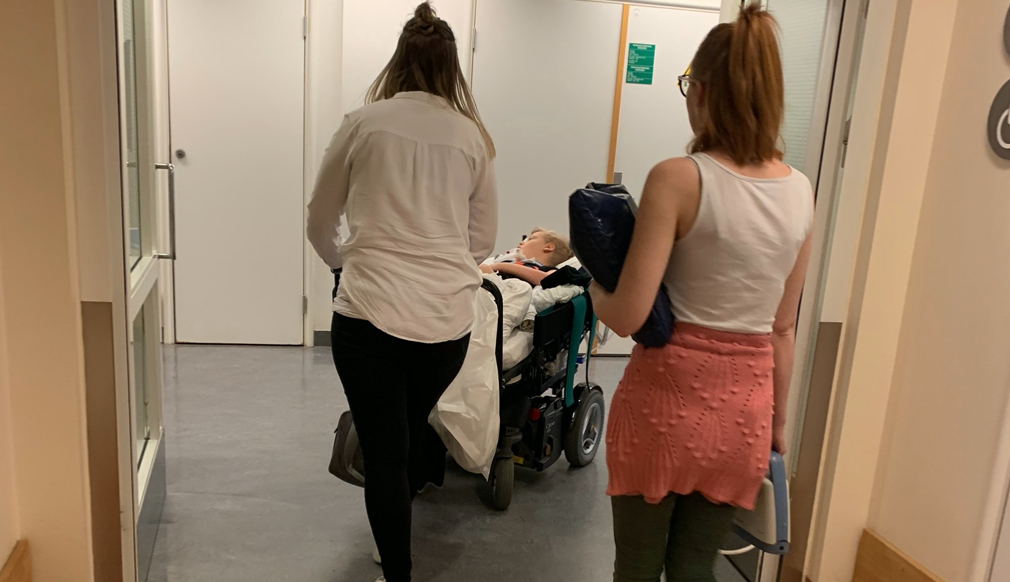
In this post, you can read about Elin and Nina, two of the board members in our organisation, who both have BPA plans for their children that include healthcare. Elin has health care without a specialist, while Nina has health care with a specialist. We hope the stories of Elin and Nina can be of help and motivation when you apply for BPA for children with medical assistance needs.
ELIN
BPA with unskilled assistants and advanced healthcare.
William's BPA scheme is great and wonderful proof that health care can be included in BPA even if you are not entitled to it in law (yet). The only thing that is needed is that the specialist health service/doctor who follows the child (or other agencies that follow the child closely) believes that it is justifiable and can be carried out, and that the municipality shows some goodwill.
William has a serious and rare muscle disease. He has a tracheostomy (breathing tube in a hole in his throat) with a ventilator connected around the clock. He is thus dependent on machines around the clock in order to live. He also has a cough machine so he can cough. He is suctioned with a suction machine in both his mouth, throat and trach regularly throughout the day and at unspecified times.
William has a button on his stomach and gets all his food through it.
Because of. that he is extra exposed to respiratory infections, he has a few rounds of antibiotic courses. a year and then receives the medicine through the button.
Since he was born, William has therefore needed advanced health care, which I, as a mother, was taught in the hospital. We stayed at the hospital for approx. 4 months before we could move home. After that, there have been many hospitalizations, both planned and emergency. Despite his serious illness, he has been mostly at home and missed a lot of hospital stays thanks to what I have learned about my child and the fact that his assistants have always been up to date on how William must be doing. I have trained the assistants and over time, safe assistants have also trained new assistants in collaboration with me.
When we moved home from the hospital, we got "personal assistance" in place. It started with only night shifts when I had no idea what rights we had. Over time, more and more hours of assistance were put in place to look after William - both keeping him alive and ensuring a dignified life. After a few years I wanted to change the service to BPA as I was already doing everything that was part of the foreman role for BPA. We got that. After a couple of years with a well-functioning BPA scheme, the municipality thought that William should no longer have BPA and wanted to replace it with "stationary home nursing care" and thus also replace all personnel, which was completely out of the question for us because William must have safe people around him. I complained to the State Administrator (formerly the County Governor) and was fully upheld in keeping BPA for William despite a lot of health care. What I put forward as a proposal was that I could send a "report" to the municipality regularly on how everything is going (see attached example) and that you can have a nurse, either in the BPA scheme or with a BPA supplier (private or municipal), who has a "nursing responsibility" who receives these reports. Below you can download an example of the report.
William has a large BPA scheme with a decision on 2 assistants at the same time around the clock.
As of today's date, we only have 1 assistant on night duty in the decision and use the hours at other times. It is used e.g. for tasks where William needs 3 assistants, when training new assistants, for holidays or when I, as a mother, need relief. When we have training for new assistants, it is important for William to continue being a child and that he has his needs taken care of by a safe assistant, while the other assistant has training with the new person, etc. When offloading, should I do anything else, it is important that there are 3 assistants where at least 1 of the assistants is well known, well trained and completely confident about everything concerning William.
Life with BPA gives us the opportunity to feel freedom, happiness and normalcy. We are like any other family and have the same dreams of a good life. We with children who need healthcare must also be allowed to live freely and independently, and for us the only option is to have the service organized as BPA.
- Elin Gunnarsson, supervisor and mother


NINA
BPA with skilled assistants and advanced healthcare.
It is entirely possible to have good and sound BPA schemes for children who need advanced health care. There is nothing in the legislation to prevent it, but unfortunately there is no right. Therefore, as of now, you are completely dependent on a municipality that sees the child's best interests and understands that children need few people to relate to, and that advanced health care included in the BPA scheme will benefit both the child and the family. Not least, it will create greater security and security around the child if everything is baked into the same service.
Edvan has a fantastic and well-functioning BPA team around him with super talented assistants. The team consists of both unskilled and skilled assistants. Edvan has his own intensive care nurse with 18 years' experience employed in his team who relieves me of all the nursing tasks.
Edvan has Down Syndrome and was born with a serious heart defect that was corrected by open heart surgery at 2 months of age. He has sleep apnea, bradycardia (low pulse/pulse drop) and sleeps with CPAP with a full face mask, and must therefore be monitored during sleep.
He also has a serious and rare intestinal diagnosis called KIPO. KIPO stands for chronic intestinal pseudoobstruction. This means that his bowel behaves as if there is an obstruction in the bowel without actually being a mechanical obstruction. The reason for this is that the nerve cells and muscle cells in the intestine are not doing their job. They are in a sense out of order in periods and in the other periods they function very poorly. This affects peristalsis in the intestine to a large extent and leads to intestinal failure. He has/had reduced nutrient absorption, enormous constipation problems, diarrhoea, hugely bloated stomach, vomiting and pain. That is why Edvan has had his small intestine laid out so that he has a bag on his stomach, called an ileostomy. This has helped him a lot. He has less pain now and no more constipation. Even so, Edvan cannot tolerate the amount of food he needs. He vomits and suffers from too much tube feeding and it is not enough for him to grow and develop with what he tolerates. He must therefore also receive nutrition intravenously (parenteral nutrition, often abbreviated as PN or TPN (total parenteral nutrition).
In order to receive nutrition intravenously, a central venous catheter is needed - a catheter that is placed in one of the large veins leading to the heart. One cannot give intravenous nutrition with fat in a normal vein. Edvan has therefore operated on a VAP. That is to say, he has operated on a chamber under the skin where there is a pad you can stick through, which in turn leads to the entrance to the catheter that has been inserted into his main vein. This catheter ends up in the entrance to the heart. This means that there is an extreme risk of infection if you handle any of the equipment, nutrition or procedures incorrectly. We have completely sterile procedures for everything to do with the intravenous nutrition, to avoid life-threatening blood poisoning (sepsis). It is also very important to avoid infection to prevent having to operate on the catheter to replace it. There can then be scarring in the vein which means that you cannot use the same vein again. We humans only have 4 (6 if you can use the groin) entrances to have central venous catheters in. If these are used up, the nutritional possibilities will disappear with enormous consequences for the child.
I myself have been trained in all of Edvan's nursing tasks and am the one who is both responsible and who performs all the sterile procedures on a daily basis. When we have relief, it is absolutely necessary that, in addition to the assistants, there is a permanent nurse who is responsible for carrying out the sterile procedures. The nurse is also on call at night, as I usually am myself, should something happen during the infusion that the usual BPA assistant cannot handle. There must always be 2 adults present during the period when Edvan is connected intravenously.
Our municipality required that the BPA assistant who was to be responsible for intravenous in my place during relief had nursing skills. The hospital had approved that unskilled BPA assistants could carry out this after good training and practice, but our municipality made demands for nurses. I find this to be safe and good.
The nurse position was announced by me as a supervisor, in the same way as when I hire unskilled assistants. The nurse was employed as a BPA assistant in the BPA company we use. For the hours in our BPA resolution where a requirement is made for a nurse, the municipality has included an extra nurse's salary. This is how it has to be. If vocational training is required, then additional wages must also be entered from the municipality. The nurse is obliged to keep records according to the Health Personnel Act. We solve this by having me as supervisor send in a copy of journal notes from our journal book to the municipality every month.
Edvan has a relatively large BPA scheme of 120 hours a week which contains:
- cover for awake night watch every night
- relief 6 days per month incl. double staffing at night (nurse and assistant)
- holiday relief of 7 days per year with double staffing at night (nurse and assistant)
The hours with nursing coverage constitute a 60% position and are completely user-controlled, as BPA should be. This means that we decide when and how the hours with nurses are used.
Everyone who works in Edvan's scheme has received good training from Ullevål hospital, as well as long training and education here at home from me. They have received training in everything to do with intravenous, in addition to everything else: stoma, CPAP, pulse oximeter, tube feeding etc.
As a supervisor (and mother), I attach great importance to Edvan's service being safe and reliable, just like the municipality. Previously, we had the nursing duties organized as home nursing. Unfortunately, it was a bad experience. This is based on how home nursing is organised. There were too many nurses for Edvan and they did not get to know him well enough to interpret him, nor did they receive good enough training as they were here too rarely. We were also trapped in our own municipality as home nursing does not provide services beyond the municipal boundaries. We also couldn't apply for home nursing care on holiday in another municipality because such a long training period is required.
It is only after we got everything within the BPA that we got the security we should have for it to be a relief, and we can function more like other families. BPA has given us our freedom back and is highly recommended! Don't let the child's need for health care be an obstacle.
- Nina Bakkefjord, supervisor and mother


 English
  Norsk bokmål
  العربية
  Français
  Deutsch
  हिन्दी
  كوردی
كوردی  فارسی
فارسی  Soomaali
  Español
  Kiswahili
  தமிழ்
தமிழ்  Tigrinya
  Українська
  اردو
اردو